

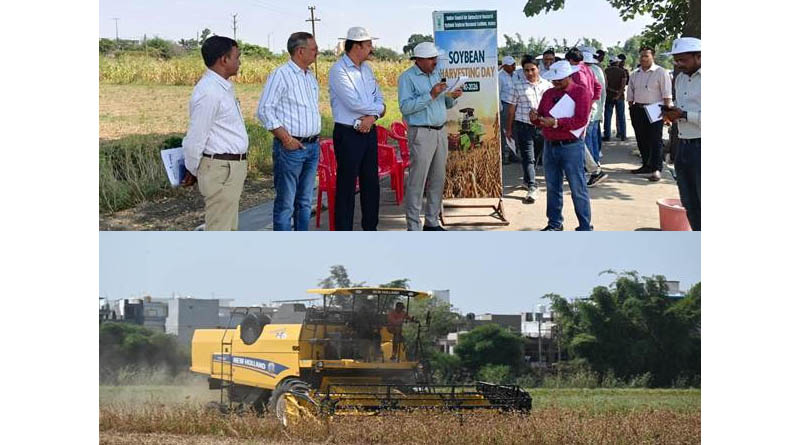
A promising soybean variety must do more than produce an impressive result once. It has to perform in the soils, weather and management systems where growers will use it. Preliminary harvest assessments of NRC 268 and NRC 270 in Indore offer an encouraging starting point for that larger investigation.
Understand what the initial harvest shows
The ICAR–National Soybean Research Institute assessed one acre of each variety and reported yields approaching 20 quintals per hectare despite adverse weather. That is approximately two tonnes per hectare. The figure compares favourably with India’s average soybean productivity of around 10–11 quintals per hectare, but the two measurements describe different populations and conditions.
A national average brings together farms with different inputs, rainfall, soils and production constraints. A small harvest assessment captures a much narrower situation. Comparing the two can indicate the scale of opportunity, while establishing a dependable advantage requires repeated tests against appropriate local alternatives. The preliminary result should therefore inform the next questions, rather than settle them.
Assess the variety within the production system
Work by the institute and the All India Coordinated Research Project on Soybean indicates that improved varieties combined with suitable production practices can achieve 15–20 quintals per hectare. Under favourable conditions, the reported potential is higher, at 22–25 quintals. Those ranges describe possibilities within research and management contexts; they are not a guaranteed outcome for every field.
For a grower, the relevant comparison includes whether maturity fits the local season, whether the crop can be managed with available resources and how consistently it responds to variable conditions. Recording the production context makes a yield figure more useful. Without that context, a number can be accurate yet difficult to translate into a farm decision.
Use several seasons to distinguish potential from reliability
The institute plans further analysis of the harvest data and emphasises the value of assessments over multiple years. Repeated observations can reveal whether an apparent gain persists through different weather patterns or depends on a particular set of conditions. Testing in several regions also helps identify where a variety is well matched and where another option remains preferable.
Research, extension and farmer outreach connect these measurements with practical adoption. The most useful message from the Indore assessment is that there is a result worth examining carefully. Combining stronger genetics with transparent field evidence gives growers a better basis for judging both the opportunity and the uncertainty before changing their seed choices.
