

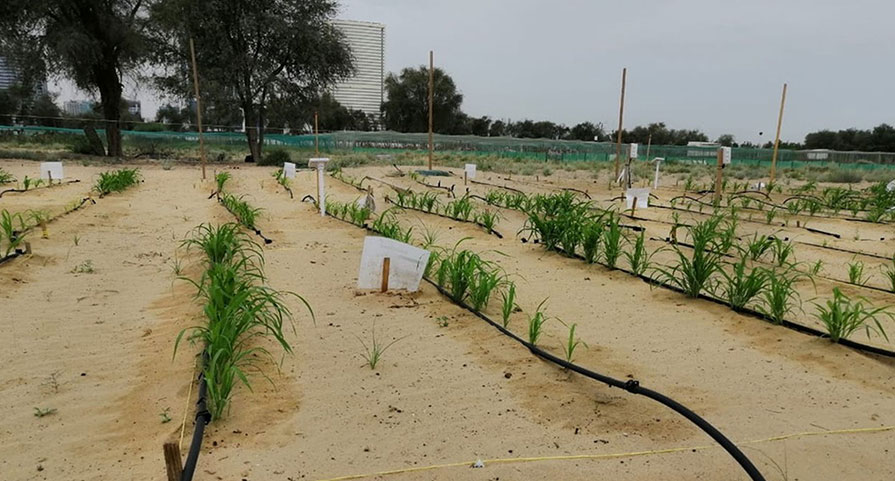
Turning a desert plot into a growing area raises two different questions. Can crops establish themselves there, and can the approach become a practical way to produce food? A successful planting helps answer the first. The second requires a closer look at water, operating costs, environmental effects and the ability to repeat the result beyond a single demonstration.
What the Dubai trial demonstrates
A Desert Control trial in Dubai used Liquid Nanoclay on a plot growing watermelon, zucchini and pearl millet. The treatment combines clay with water to improve moisture retention in sandy soil. Testing with the International Center for Biosaline Agriculture brought the approach into a setting where crop performance could be examined in the field.
Different crops provide different kinds of information. Establishment, growth and harvest need to be assessed for the crop actually being grown, rather than inferred from another crop’s success. A productive plot is an encouraging starting point, but a farming system must keep delivering useful results as conditions and management change.
Measuring the water behind the harvest
Water efficiency becomes meaningful when inputs and outputs are considered together. A farm can use less water because management has improved, but it can also use less because production has fallen. Comparing irrigation volume with harvest quantity and quality helps distinguish a useful improvement from a reduction that comes at the crop’s expense.
Soil observations add another part of that picture. Tracking moisture through the profile can show how quickly water moves away from the roots and how long conditions remain suitable between irrigations. Connecting those observations with irrigation records gives growers a stronger basis for deciding when to water again.
Building an operation around the treatment
Moving from a trial to a larger deployment is also an operational challenge. Material has to be prepared, transported and applied consistently. Irrigation equipment, access to the field and the availability of staff influence how easily the work can be integrated into an existing farm. Increasing production capacity does not, by itself, resolve every one of those questions.
The economics need the same practical attention. An application cost is only one item in a farm budget. Energy for pumping, water supply, labour and the value of the resulting crop all contribute to the decision. An affordable treatment must fit the grower’s operating model as well as demonstrate a benefit in the soil.
Expanding carefully in a desert environment
Desert land is not simply unused space. Choosing where to develop agriculture requires attention to the existing environment and the resources a farm will need. Productive use of a suitable plot and responsible management of the wider landscape are related goals, but they should not be treated as interchangeable.
The strongest route forward is a sequence of measured decisions: test the ground, establish a clear comparison, follow the crop through harvest and review both benefits and costs before expanding. The Dubai trial gives that discussion a concrete field example. What matters for wider adoption is whether growers can reproduce the benefit under their own conditions and sustain it as part of everyday farming.
